
Valve encrypts match chat: the end of the sites exposing your history
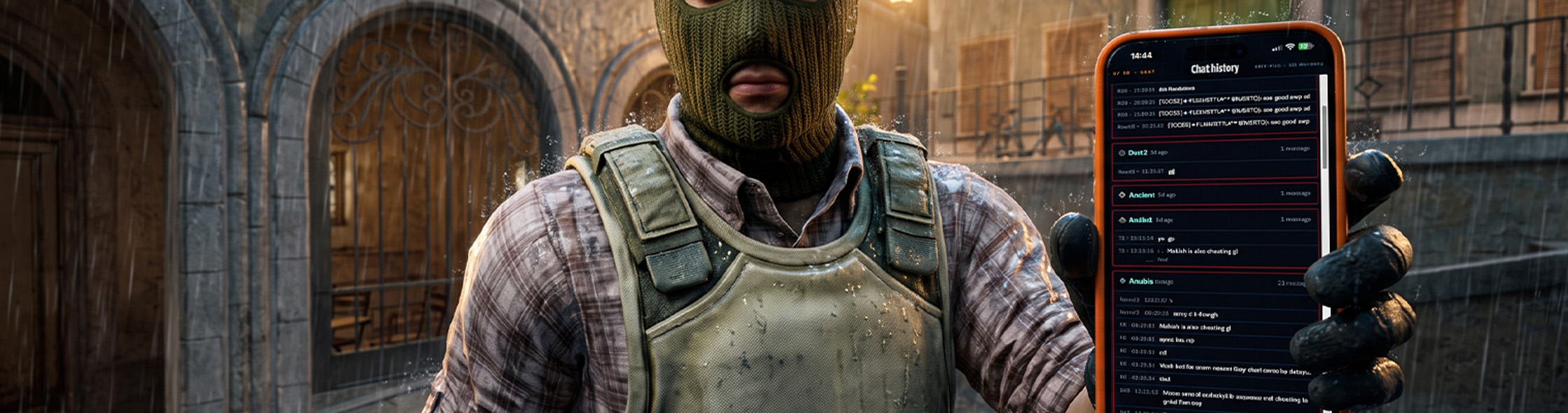
It was only a matter of time, and it's here. The update Valve released last night brings a change that settles one of the most-discussed controversies of recent weeks in one stroke: match chat is now encrypted inside demo files.
Until now, replay files stored messages in plain text. That meant anyone with the right tool could extract them after a match ended, without even opening the game. And that was precisely the root of the problem.
Exactly how it works now
The change distinguishes between two types of chat, and the difference matters:
- Team chat is now completely unreadable in demos. No tool and no website can extract it, regardless of how the file is opened.
- Global chat can still be read, but only through the demo player built into the game itself. External extraction tools no longer work.
With this, CS2 falls in line with the system Valve already used in CS:GO. It isn't a new invention, but the restoration of behavior the game lost in the transition to Source 2.
Why it was inevitable
We covered the trigger two weeks ago. In late August, a stats website began indexing players' chat messages and tying them to their public profiles, turning fleeting conversations into an archive searchable by name. Some profiles held thousands of messages, each with its map, round, and timestamp. One indexed account passed 2,800 messages across 388 matches.
And the detail that caused the most discomfort: you didn't need to register on the site for your data to appear there.
What started as a curiosity — with CaseOh's and s1mple's logs circulating as memes — quickly turned into something considerably less funny. The community wasted no time compiling rankings of the game's most toxic and offensive players, and at that point it stopped being an anecdote and became a privacy problem with serious legal implications depending on the country.
Valve has opted to cut it off at the root. From now on, everyone gets to swear in the privacy of their own match.
The Cache changes
The rest of the patch covers maps, and has its own eye-catching detail. On Cache, Valve has:
- Added a missing competitive CT spawn point. In other words, the CT side's starting positions weren't the intended ones — and the map has been in Active Duty since July.
- Added additional Terrorist spawn positions. This can have real tactical consequences: new spawns may open direct utility lineups from previously unavailable positions or speed up arrival at certain sites.
- Fixed a wallbang on B site.
- Closed various gaps in the geometry.
More tools for creators
On the scripting side, the most significant change is the rework of the player camera system, renamed and expanded with new functions to query and set modes and configure follow behavior. The read is that Valve wants to add depth to the tool, enabling more elaborate camera angles and movements.
There's also been considerable work on the custom HUD: you can now control whether an observer sees the HUD as the spectated player does, bugs when changing spectator targets have been fixed, and classes tied to client state have been added.
It isn't content, but it matters: since the last major scripting update, the community has thrown itself into experimenting with the possibilities. At this point you can already play versions of Wolfenstein inside CS2.
And one bonus piece of good news
To close, a note that doesn't appear in the patch notes but is confirmed by dataminer aqua: the exploit allowing cheaters to force match cancellations via VAC Live has been patched.
That means from now on, if VAC Live triggers in your match, it's because the system has actually detected a cheater — not because someone decided to blow up the game for fun.
It's the patch's best news after the chat encryption, even if it arrives without an official headline. New content, on the other hand, is still absent: for that we'll have to wait a little longer, with the game's third anniversary just around the corner.
Source: Valve patch notes, FPSHUB, aqua (@aquaismissing).